Start with monitoring. Build toward audit-ready LabOps infrastructure
Customers may first see sensors, alarms, temperature, humidity, or gas readings. The real value comes
when those signals are connected to equipment state, sample risk, people response, SOP requirements,
and audit evidence so daily lab operations become continuously managed, improvable, and easier to defend.
Seven physical lab scenes. One way to choose the first conversation
Treat the seven scenes as a navigation map: pick the operating pressure your team recognizes, then open the scenario, brochure, and demo route that match it.
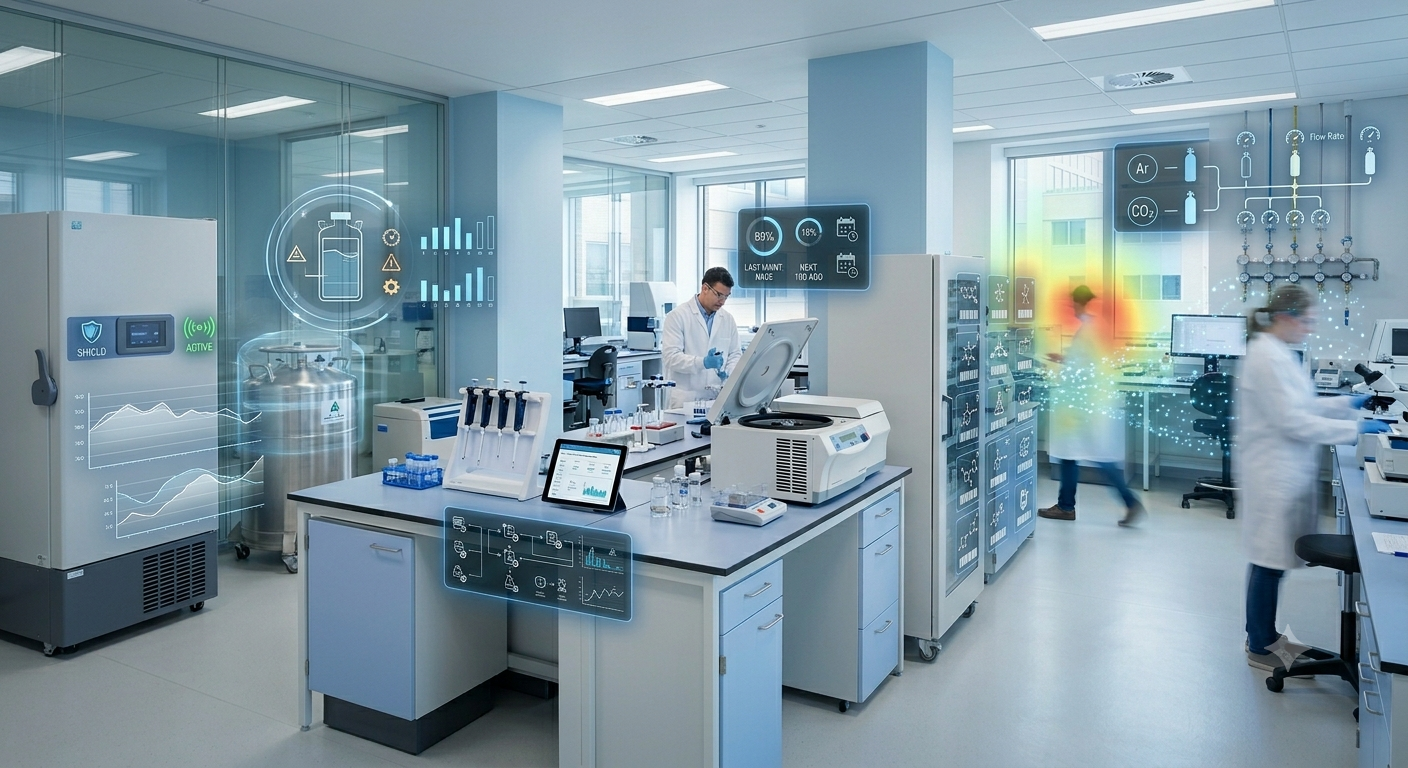
Illustrative view of the seven common physical lab scenes iLabService connects into traceable operating records.
Seven operating scenes
Start with the scene that creates the most operational risk
Use the integrated lab view and the map below to jump into the freezer, cryo, incubator, equipment, inventory, space, or gas workflow that looks most like your daily operation.
Ultra-low freezer and biological storage governance
Move beyond manual freezer checks by connecting temperature, compressor status, door state, power, access, sample records, escalation, and maintenance context so teams can see compressor risk before internal temperature exceeds limits.
Manual today
Rounds, paper logs, screenshots, and late temperature exports.
AIoT with iLabService
Temperature, door, compressor, power, access, and sample context stay linked.
Evidence produced
Review-ready excursion, response, corrective-action, and QA packet.
Cryogenic safety
Cryogenic storage and oxygen safety
Reduce manual gauge checks and delayed refill response through LN2 level visibility, oxygen monitoring, pressure context, refill planning, and auditable safety records.
Manual today
Gauge checks, refill calls, and oxygen monitor records remain separate.
AIoT with iLabService
LN2 level, pressure, oxygen, access, refill, and supplier context align.
Evidence produced
Traceable safety, refill, access, and EHS review record.
Experiment integrity
Incubator and chamber conditions during experiments
See CO2, temperature, humidity, door openings, room state, and power events across the exact experiment window instead of relying on scattered condition notes.
Manual today
Condition notes, instrument exports, and failed-run context are reconstructed later.
AIoT with iLabService
CO2, temperature, humidity, door, room, and power events map to the run window.
Evidence produced
Experiment-window record for deviation, reproducibility, and methods review.
Equipment intelligence
Lifecycle and utilization management
Reduce manual booking, maintenance follow-up, and usage estimation by connecting reservations, access, performance, energy, consumables, and budgeting evidence.
Manual today
Bookings, service notes, usage estimates, and power data live in separate places.
AIoT with iLabService
Reservation, access, runtime, service, energy, and consumable signals share one asset record.
Evidence produced
Utilization, maintenance, downtime, lifecycle, and budget-support evidence.
Material governance
Chemical, reagent, and consumable inventory
Move from spreadsheets and periodic stocktaking to identity-linked transactions, smart cabinets, labels, expiration control, and consumption analytics.
Turn routine lab events into monitoring, workflow, evidence, and optimization
iLabService is built for the moment when a signal stops being just a data point and becomes part of
daily operations: who owns the risk, what should happen next, what evidence is created, and how the
lab improves over time.
01 Sense
Physical lab scene
Freezers, cryo storage, gas, rooms, equipment, cabinets, people actions, and material movement.
Capture acknowledgement, correction, review, and approval
04 Learn
Reusable evidence
Reusable records for audits, risk patterns, utilization, forecasting, benchmarking, and management review.
Turn daily operations into comparable site records
Support audit evidence, trend analysis, and operating decisions
Why LIMS and ELN are not enough
Scientific records show what was entered. They often lack the physical signals around the event
iLabService complements LIMS, ELN, booking, and paper records. The gap is not in what those
systems record; it is in the physical activity they cannot see between human entries.
Existing systems can record
LIMS, ELN, booking systems, and paper logs
Experiment inputs
Protocol notes, reagents, sample IDs, batch information, and analyst entries.
Sample registration
Check-in, storage location, chain-of-custody, transfer, and disposal records.
Equipment booking
Reservation time, user, method, planned usage, and service requests.
Manual exports
Temperature files, paper checks, screenshots, or copied values prepared after review starts.
Lab operating records gapWhat changed between human entries?
Lab operating records often missing
The physical reality that changes outcomes
Door and access events during the run
Who opened the freezer, cabinet, incubator, or room, and for how long.
Power and utility disturbances
3 a.m. voltage changes, gas alarms, camera-read cylinder gauges, O2 readings, pressure shifts, or local outages.
Actual usage versus booked usage
Real equipment power patterns, run time, idle time, and abnormal utilization.
Response and corrective action context
Who received the alarm, who acknowledged it, what was corrected, and what QA can review.
iLabService fills this right-hand column.
Physical signals become governed operating records that can be linked back to scientific records, samples, spaces, assets, and audit evidence.
Manual mode vs AIoT mode
The difference is what you know, when you know it, and what you can prove
Lab managers do not buy a platform because it sounds modern. They buy it when it removes the
daily uncertainty around samples, safety, equipment utilization, inventory spend, procurement
decisions, and audit evidence.
Friday night test
What can you prove by Monday morning?
You leave the lab after the last check.
Compressor status begins showing abnormal recovery behavior.
A -80℃ freezer crosses the configured temperature threshold.
The first person notices something is wrong.
You start rebuilding the event from logs, screenshots, chats, and memory.
QA asks for the last 72 hours of operating evidence.
Manual mode: what you can usually find
Partial temperature export or screenshots
Little or no compressor-status history before the temperature excursion
Paper log entries with time gaps
Chat messages about who saw the alarm
Unclear acknowledgement and response timing
Result3-6h reconstruction work
QA still has to verify timing, ownership, and whether the records tell the same story.
iLabService mode: what is already assembled
Compressor-status warning before the temperature excursion
Temperature curve and threshold breach time
Door, access, power, and location context
Alert routing, acknowledgement, and escalation trail
Corrective action and review task history
ResultOne review-ready packet
Physical signal, response, corrective action, and QA review status stay connected.
Cryo and oxygen safety
Cryogenic storage risk
When a cryo system moves from refill issue to safety concern, the question is not only whether samples are safe. It is whether the operating record connects the event, response, and review path.
LN2 level drops below refill threshold.
Oxygen condition and access history are checked against the same room event.
Refill task, EHS response, and supplier follow-up are routed.
Manual mode
Gauge checks, refill calls, and oxygen monitor records stay separate.
Sample risk, access history, and supplier response are reconstructed later.
AIoT mode
LN2 level, pressure, oxygen safety, access, and refill context are linked.
EHS review sees one traceable record for the room, event, and response.
Audit record request
Evidence and review burden
When QA asks for operating evidence, the hard part is usually not a single record. It is stitching together the physical event, the people, the response, and the review trail.
QA asks for evidence around a deviation window.
Teams search exports, screenshots, paper logs, and message threads.
iLabService exports the event packet with review-ready context.
Manual mode
Teams assemble screenshots, exports, paper logs, and message threads.
QA still has to verify timing, ownership, response, and approval gaps.
AIoT mode
Signal timeline, alerts, tasks, corrective action, and review trail are connected.
Records are organized around SOP, deviation, OOS, or audit evidence requests.
60-second walkthrough
See how common lab events become evidence packets
Switch between scenes and step through the operating record a lab manager, QA reviewer, EHS owner, PI, or scientist needs when a physical event happens.
Step 1 of 5Guardian freezer room event
Sat 01:52
Compressor behavior indicates risk before the freezer crosses its threshold
Current temperature-79℃
Still within range · Setpoint: -80℃
Compressor statusRisk rising
Abnormal recovery and power pattern detected
Sat 01:52-02:04
The early warning is tied to compressor, door, and sample context
Door events01:56 opened · 02:03 openedAccess history attached to the same event.Compressor signalExtended recovery cyclePower-pattern behavior suggests cooling risk before temperature excursion.Samples at riskRack B · Shelf 3Storage map links affected sample positions.OwnerCell culture teamSOP owner and backup contact resolved.
Sat 02:04-02:31
Escalation moves while the freezer can still be saved
01:52Compressor risk detected
Guardian creates an early warning before internal temperature exceeds the limit.
02:04Primary owner notified
Mobile alert sent with compressor, trend, and sample context.
02:18No acknowledgement
Escalation rule starts after the configured response window.
02:21Backup owner notified
Guardian records who received and acknowledged the event.
02:31Facility response started
Work order and response note are attached to the same incident.
Sat 03:05
The preventive response becomes part of the governed record
Corrective actionCompressor check opened. Backup freezer prepared before sample exposure.
Technician note captured with timestamp.
Compressor behavior and temperature trend reviewed together.
Sample exposure window marked as avoided or requiring review.
QA review task opened against the incident.
Monday 09:12
QA reviews one packet instead of chasing screenshots
Compressor-status warningTemperature curveDoor and access historyAlert acknowledgementCorrective actionSample risk window
The incident is exportable as a review-ready package showing the early compressor risk, physical signal history, ownership, response, and SOP-linked evidence.
Live demo · high-intent review
Open a live LabOps dashboard after the walkthrough
Use the demo view to compare the 60-second incident narrative with a live dashboard environment for connected laboratory operations.
Deployment advisor
Get a recommended starting path in three clicks
Choose the risk, current monitoring method, and network reality. The advisor turns the product catalog into a practical first deployment recommendation.
Manual vs AIoT
Traditional manual mode
iLabService AIoT intelligent mode
What changes
Scene image
Scenario demo
Choose the pressure point, then map the first deployment
Use the advisor result or bring one freezer room, gas room, incubator bay, equipment utilization,
inventory workflow, audit request, or EHS concern. We can map the connected hardware, workflow,
evidence packet, and first operating review.